Yesterday in Aviation History: Harrier in Havelock
Contributor: Barry Fetzer
Sources: Conor Knighton, author of the book, “Leave Only Footprints”, FRC (East), AI and other sources on the decibel levels of AV-8 aircraft
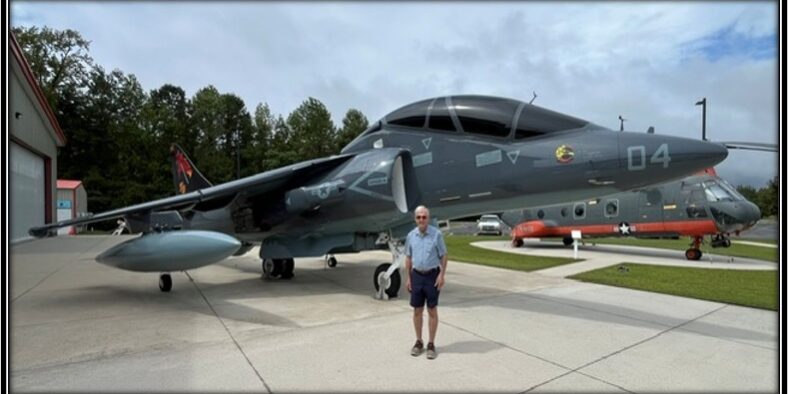
Those of us here in the Sandhills likely didn’t hear about yesterday’s activities at the Tourist and Event Center (TEC) in Havelock, NC (home of MCAS Cherry Point) in dedicating the “T-bird” or the TAV-8B (two-seater training) aircraft (Bureau Number (BUNO) 163186) recently delivered, effectively “by hand” (with the minor help of a tug…see the below photo). You missed a unique event that I was fortunate to attend.
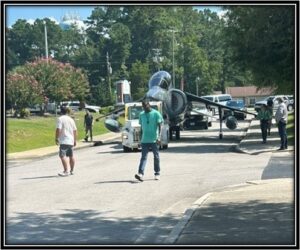
FRC East Photo of TAV-8B BUNO 163186 being “walked by hand” to the TEC from FRC East to the Havelock Tourist and Event Center and Aviation Heritage Museum
With Havelock Mayor pro tem and Commissioner Brenda Wilson officiating on behalf of the City of Havelock and a litany of distinguished guests including AV-8 flyers and maintainers, representatives of our Naval Aviation Depot Fleet Readiness Center East (FRC East), including the Commanding Officer (CO), and the artisans of the FRC…all of whom did a superb job preparing, demilitarizing, painting, and delivering the aircraft to the TEC.
Inspiring speakers reviewed the history of the AV-8 itself and the T-Bird aircraft being dedicated as the newest addition to Havelock’s and the Eastern Carolina Aviation Heritage Foundation’s (ECAHF) “squadron” of historical aircraft on display. These speakers included the Naval Aviation Acquisition and Support Program Management Office (NAVAIR PMA-257) responsible for lifecycle support of the aircraft and the former CO of 2d MAW’s VMAT-101, the Harrier training squadron that flew the TAV-8B being dedicated. Colonel “Oscar” Myers had, according to his logbook, flown seven flights in that aircraft while CO of the squadron.
A traditional ribbon cutting officially dedicated the aircraft with maintainers, pilots, city and military leaders, former MCAS Cherry Point commanding general and current Chairman of the ECAHF, Tom Braaten, and others.
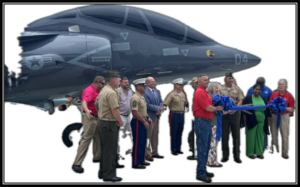
Ribbon cutting and dedication ceremony photo courtesy of Barry Fetzer
Please stick with me here: there’s a “rest of the story” (with apologies to late radio announcer Paul Harvey) as I take you through a bit of Harrier lore in this historical vignette that is a bit longer than most.
What was left out of the comments yesterday at this dedication ceremony must be a part of the story—the history—of the AV-8 “Harrier”. The Harrier story is incomplete without talking about its sound, or more accurately stated, its noise. The Harrier was loud, one of the loudest—if not the loudest of our military jets and certainly a winner in the decibel sweepstakes.
According to Conor Knighton, author of the book, “Leave Only Footprints” (where he describes his visits of every US National Park), “The decibel scale measuring noise must be logarithmic because of the remarkable range of sounds our ears can detect.” He goes on, “A lawn mower (90 decibels) isn’t one and a half times as loud as normal conversation (60 decibels), it’s 103 , or a THOUSAND TIMES louder. The loudest sound we can process—something like a jet plane taking off at close range—is one TRILLION times louder than the decibel level of [silence].”
And a “trillion” describes the Harrier very well. So does a “cacophony”, which means a loud, harsh, or unpleasant mixture of sounds. While the dedication ceremony yesterday was very pleasant in every way, from the officiating, to the great people of all walks who made it and the Harrier possible and contributed to its success, to the sights and sounds of the event, to the cake and punch afterward, the AV-8 aircraft, itself, could be described as producing a shattering cacophony, especially aboard ship.
According to several sources, an AV-8B Harrier jet emits between 125 decibels (dB) and 130 dB when measured from 100 feet away during a vertical takeoff. If measured closer—such as right next to the engine or directly on the flight deck—the sound level spikes dramatically to 140 dB to 150 dB, which is well past the human threshold of pain and can cause immediate, permanent ear damage without protection.
The Harrier is uniquely loud. While all military fighter jets are incredibly loud, the Harrier produces a distinct, piercing sound profile due to its vertical/short takeoff and landing (V/STOL) mechanics. One of the reasons is a process called “Jet Impingement”. During a vertical takeoff, its powerful Rolls-Royce Pegasus engine directs its exhaust downward through four vectoring nozzles. According to NASA acoustic testing, when these exhaust blasts slam directly into the ground or a ship’s flight deck, the “ground effect” amplifies the noise by an extra 14 to 17 decibels compared to a conventional jet taking off horizontally into free air. Also, there’s the high-pitched Harrier engine whine. Rather than a low roar, the Harrier is famous for a metallic, high-frequency compressor whine that ground crews often described as “uniquely punishing”.
And I was humbled to experience the Harrier C2 , C-squared, “Crushing Cacophony” first hand. The below series of photos shows one of the AV-8B aircraft assigned to the Flying Tigers of HMM-262 (reinforced) aboard the USS Belleau Wood (LHA-3), one of the six AV-8B’s in my squadron when I was in command of that outfit in a galaxy far, far away, and a long, long time ago. I stood just a few feet away from that aircraft snapping these photos. For those of us who “put up” (it is the “sound of freedom after all, right?) with the noise of AV-8A’s and B’s for years taking off from and landing at MCAS Cherry Point, I can tell you that standing a few feet away from a full throttle AV-8B launching from the flight deck of an aircraft carrier, the word “cacophony” doesn’t even begin to describe the feeling of the intensity of the ear-crushing, bone rattling, noise piercing every part of your body. What a rush!
Could it be, perhaps, that’s why I have a decent excuse these days for why I don’t hear my wife very well? That’s my excuse, Arlene, and I’m sticking with it 😊.
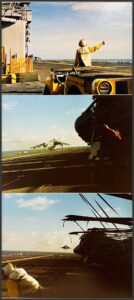
Harrier Launch photos courtesy of Barry Fetzer aboard the USS Belleau Wood (LHA-3), circa 1995
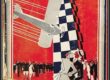
Again, with apologies to Paul Harvey, here is “the rest of the story”. One of the attendees at our dedication ceremony yesterday was a friend of mine who I invited to the ceremony, Pat Owen, a former Marine, and also a former Cobra (US Army trained) Vietnam-era pilot who transitioned to Harriers in the early 1970’s. He flew the AV-8A, the first version of the iconic aircraft and the one that earned the unfortunate moniker of “Carolina Lawn Dart” due to its difficulty in flying and its frequent crashes. Note the pilot’s name emblazoned on the fuselage of the AV-8A AMT model box top depicted below. Pat humbly recounts the story.
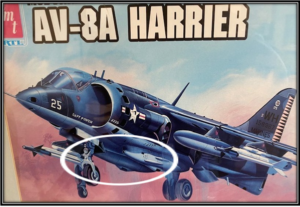
AMT Model Box Cover of the AV-8A photo courtesy of Pat Owen. Note his name circled in front of the port engine intake.
“My claim to fame is that every AV-8A model airplane that has a name on it depicts ‘Capt P Owen’. Pat says it’s from a random picture that the model companies happened to pick to print their model box tops.
“I tell my fellow Harrier community members that I was far from the best Harrier pilot, but I’m the only one whose name is on all the model planes.”
Now you know the “rest of the Pat Owen story.” The “model for the model” was Marine aviator, Pat Owen, photographed below, who attended the TAV-8B dedication ceremony yesterday.
So, he has a pretty good excuse—like me perhaps—for not hearing his wife. My excuse is a little weaker if truth be told. I never flew the Harrier. I just commanded it and watched it noisily (and longingly with thoughts of what I missed by not flying it) launching from the Belleau Wood’s flight deck.
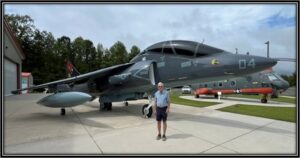
Pat Owen in front of our Havelock, NC and ECAHF TAV-8B “T-Bird”. Photo by Barry Fetzer
Onward and upward!
Sources: Conor Knighton, author of the book, “Leave Only Footprints”, FRC (East), AI and other sources on the decibel levels of AV-8 aircraft