This Day in Aviation History–The Day After
Contributor: Barry Fetzer
Sources: FEMA
Today, twenty-five years ago on September 12, 2001, America woke up a different nation after the 9-11 terrorist attacks against our nation in NYC, Arlington, VA (the Pentagon) and in Shanksville, PA where United Airlines Flight 93 crashed in a remote, wooded area after passengers attempted to take over the plane from the terrorists who had hijacked it. Were it not for the passengers on Flight 93 who voted to fight back, Washington, DC would have likely been a third target.
Those of us older than six or seven at the time remember vividly the attacks on America by four commercial aircraft as one of our defining memories.
While we might not have been directly impacted by losing a loved one, 9-11 displayed the human connections we all share and many of us know someone who was directly impacted. A neighbor of ours here in Southern Pines shares this memory: “We were in the city that day and knew about six who were killed. Everyone in NY knew someone. My godson, a firefighter, spent months down there and still suffers from it every day. A cousin, a rookie firefighter, 9/11 was his first run. One of my takeaways would be that if it had to happen it was best in NYC with their resources and the way in which everyone came together was absolutely heartwarming.”
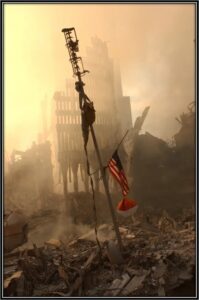
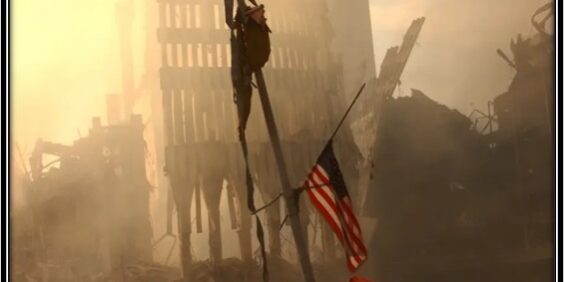
New York, N.Y., September 13, 2001 — The airplane alert antenna sits firmly in the ground amidst the rubble. Originally it was on the roof of the World Trade Center.
Photo by Andrea Booher/ FEMA Photo News (FEMA Photo by Andrea Booher/Released)
While air traffic was mostly completely shut down over the continental US (and many places internationally too), I somehow made it back to MCAS New River on September 12th aboard a MCAS New River UC-12B (a Beech King Air) aircraft that was permitted to take off from McConnell Air Force Base in Wichita, Kansas and fly cross country to eastern NC. I was a MCAS Cherry Point-assigned Marine on temporary duty at McConnell AFB doing military aviation training.
My wife knew the wife of the pilot of that MCAS New River UC-12B who called her husband and asked if he could wait for me to arrive before he took off. The New River pilot didn’t want to wait too long because the unlikely FAA approval of his flight plan allowing him to take off on the morning of 9-12, less than 24-hours since the terrorist attacks commenced, could be countermanded. It wasn’t and I arrived to the flight line in time and made it back home that day, thanks to my wife and the wife of the pilot in command of that New River UC-12B.
We were cleared direct from McConnell AFB to MCAS New River. During the four and a half hour or so flight home and according to the FAA controllers with whom we were talking, we were one of less than half a dozen aircraft (all military) airborne over the “Land of the Free” at the time, the fewest aircraft airborne over America since the dawn of flight.
We were all grateful for that historic flight. We all wanted to be back as soon as possible with our loved ones. It was a time we needed to hold onto each other.
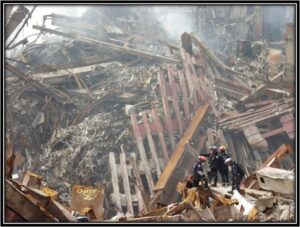
New York, N.Y.– These FEMA rescue workers are dwarfed by the pile of rubble at the site of the World Trade Center. Photo by Michael Rieger/ FEMA News Photo (FEMA Photo by Michael Rieger/Released)
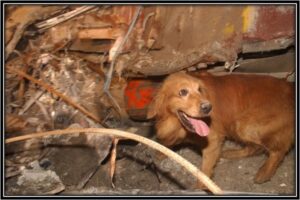
New York, N.Y. — Urban Search and Rescue Washington Task Force-1 member, Thunder, from Lakewood, Washington searches through the rubble for victims of the September 11 terrorist attacks.
Photo by Andrea Booher/ FEMA News Photo (FEMA Photo by Andrea Booher/Released)
Onward and upward! Let us never forget.
Sources: FEMA