On This Day in Flying…Whatever: Flags “Flying”
Contributor: Barry Fetzer
Sources: History.com, UShistory.org
I have an idea! Let’s have some fun with words! The word “fly” is one of those overworked English verbs that reveals just how inventive—and occasionally chaotic—our language can be. At first glance, it seems simple: birds fly, airplanes fly, insects fly. Yet once you start paying attention, you realize “fly” and “flies” have slipped into dozens of corners of everyday speech, carrying meanings that range from literal to metaphorical to whimsical.
How about “house flies fly?” The sentence looks almost comical, but it’s perfectly accurate: the insect “fly” performs the action to fly. English loves this kind of doubling, where a noun and verb share the same form, and “fly” is one of those examples. But the insect isn’t alone. Birds fly, bats fly, and even seeds fly when the wind catches them just right.
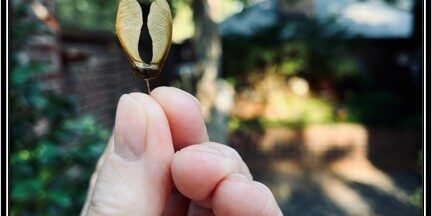
Speaking of seeds flying, we have a Trident Maple tree in our back patio that is one of the messiest trees in existence. It drops little flowers in the spring and then seeds in the summer and then sheds its leaves in late fall. Debris unceasingly “flies” off that tree causing me to man the rake, leaf blower, and tarp at least twice a year to clean up its mess.
The seeds of this tree “helicopter rotate” or “autorotate” as they fall, actually doing some minimal flying. The physics of their natural shape work to demonstrate (due to the shape of their “wings”) the Bernoulli Principle, spinning laterally to the ground in a dispersed, somewhat horizontal (as opposed to falling perpendicularly) pattern, many of them falling well beyond the girth of the tree’s boughs. Each seed’s winglet allows it to generate a little lift, flying further away from the “mother” tree than they could without that winglet. I call those seeds, “Trident Maple Flyers.”
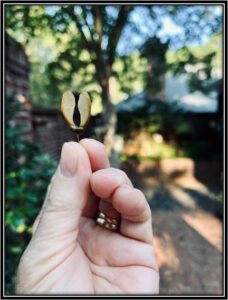
A pair of the ubiquitous Trident Maple Flyers, the seeds’ pods in this case Siamesed-together. The Trident Maple itself is in the background on our back patio. Fetzer photo.
“The Trident Maple Flyers.” That sounds like a Canada high school football team name, doesn’t it? More on football, below.
- Back to the word “fly”. From seed flyers, the word “fly” lifts off into broader territory. Airplanes fly, of course, but we also say a pilot “flies a plane,” shifting the verb from describing motion to describing control. A flag flies atop a pole, even though it’s not going anywhere; it simply flutters in the breeze with enough liveliness that English decided the verb was appropriate. Time can fly, too—an expression that captures how quickly a moment can slip away when we’re busy.
Then we get into emotional and idiomatic uses, where “fly” becomes a kind of linguistic daredevil. We fly off the handle or off the cuff when we lose our temper suddenly. We let something fly when we speak bluntly or angrily. Rumors fly when they spread quickly. A bold idea might fly, meaning it could succeed. A poorly thought‑out plan, on the other hand, “won’t fly,” grounding the metaphor in failure. We “fly off into the sunset” when leaving a job or life on this earth. In an aviator fraternity to which I belong, we raise a glass to honor fellow members of our group who have “flown west”…or flown off to the “Great Beyond.”
I’m not sure where the warning to (mostly) guys, “your fly is down” fits in here. Any takers?
English also uses “fly” to signal independence or daring. We fly solo when we do something alone. We fly by the seat of our pants when we improvise. A person might fly high when they’re succeeding or feeling confident. And if someone is fly, in the slang sense, they’re stylish or impressive—a meaning that soared out of African American Vernacular English and landed in pop culture.
Even objects get in on the action. Baseballs fly off the bat (or “soar” into the outfield). Sparks fly during an argument—or during a romance. Pages fly off a calendar. Clothes fly off shelves during a sale. The verb becomes a shorthand for speed, energy, or sudden movement.
What makes all of this delightful is that the core image never fully disappears. Whether we’re talking about insects, emotions, rumors, or retail merchandise, “fly” always carries a sense of motion, lift, or release. It’s a word that refuses to stay grounded, and English speakers seem determined to keep giving it new ways to take off.
By the way and just so you know that the work was not fully mine…it partly belongs to “it”…the “thing”…whatever “it” actually is. The above words “flew in” from Copilot’s AI…at least some of the words did.
According to the History.com editors and downloaded today from: https://www.history.com/this-day-in-history/september-3/the-stars-and-stripes-flies?cmpid=email-hist-tdih-2026-0903-09032026&om_rid=&~campaign=hist-tdih-2026-0903, and as mentioned above that flags “fly” in our vernacular, on this day in 1777, we remember the day that our Stars and Stripes flew in battle for the first time.
“The American flag is said to have flown in battle for the first time, during a Revolutionary War skirmish at Cooch’s Bridge, Delaware. Patriot General William Maxwell ordered the stars and stripes banner raised as a detachment of his infantry and cavalry met an advance guard of British and Hessian troops. The rebels were defeated and forced to retreat to General George Washington’s main force near Brandywine Creek in Pennsylvania.
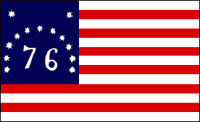
“According to some accounts, two famous flags were flown at the Battle of Bennington in August, 1777. If true, that means that the Battle of Bennington would have beaten the above History.com account by under a month. One of those flags, shown here, is called the Bennington Flag or the Fillmore Flag. The story goes that Nathaniel Fillmore took this flag home from the battlefield, and the flag was passed down through generations of Fillmores, including Millard, and today it can be seen at Vermont’s Bennington Museum. Most experts doubt this story and date the flag to about 1820. The other flag (not pictured) has a green field and a blue canton with 13 gold-painted stars arranged in rows. General John Stark gave his New Hampshire troops a rallying speech that would be the envy of any football coach today. He said, ‘My men, yonder are the Hessians. They were brought for seven pounds and ten pence a man. Are you worth more? Prove it. Tonight, the American flag floats from yonder hill or Molly Stark sleeps a widow!’”
And back to History.com, “Three months earlier, on June 14, the Continental Congress adopted a resolution stating that ‘the flag of the United States be thirteen alternate stripes red and white’ and that ‘the Union be thirteen stars, white in a blue field, representing a new Constellation.’ The national flag, which became known as the ‘Stars and Stripes,’ was based on the ‘Grand Union’ flag, a banner carried by the Continental Army in 1776 that also consisted of 13 red and white stripes. According to legend, Philadelphia seamstress Betsy Ross designed the new canton for the Stars and Stripes, which consisted of a circle of 13 stars and a blue background, at the request of General George Washington. Historians have been unable to conclusively prove or disprove this legend.”
Onward and upward! Keep ‘em flyin’!
Sources: History.com, UShistory.org