This Month in Aviation History: The Six Million Dollar Man
Contributor: Barry Fetzer
Sources: AvBrief.com and NASA
Good Memorial Day morning fellow aviation history enthusiasts. Amongst others today as I’m certain you all are, I’m remembering friends, squadron mates, and fellow Marines killed in service to our nation. These include my best friend, Major Al Butler, USMC, killed in action in Beirut near the bitter end of the time the Multinational Peace Keeping Force was deployed there until President Reagan pulled the Marines out, squadron mate and Marine Captain and former Chicago Bears Lineman “Bacca” Pagel killed in an AH-1T mishap (he hit power lines in Italy while on a training flight), and the Columbus, Ohio Reserve Marines of Lima Company, 3rd Battalion, 25th Marines whose unit was decimated when 22 of them (+ a Navy Corpsman) were killed in Iraq in 2005 mostly, by IEDs and snipers.
We honor all those who sacrifice their futures for our presents…and the families who endure their absences for the rest of their lives.
But let’s lighten the mood a bit and get into the “way back” machine and read about an aviation-related TV program many of us in the 60–90-year-old range (or more) remember. In fact, many of us wanted to “be” Colonel Steve Austin, including me.
The below column was copied in its entirety from https://avbrief.com/the-six-million-dollar-man/?utm_source=newsletter-225&utm_medium=email today and was authored by Mr. Bill Barry.
The Six Million Dollar Man’s Back Story
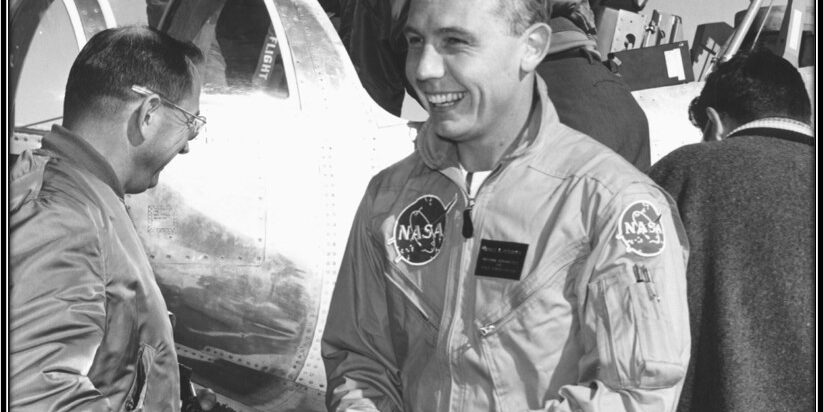
Bruce Peterson was the actual NASA test pilot in that famous crash sequence but he didn’t get any super powers out of it.
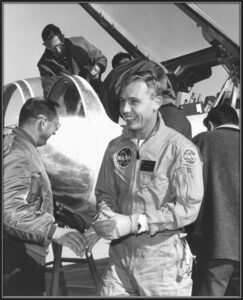
NASA test pilot Bruce Peterson after the first flight of the HL-10 lifting body in December 1966. (NASA photo)
If you are of a certain age, or maybe spend too much time on YouTube, you may remember the 1970s television show The Six Million Dollar Man. The story centered around a test pilot, Colonel Steve Austin, who was “rebuilt” with bionic legs, an arm, and an eye after a horrific crash landing. The opening credits recapped the backstory and began with footage of a lifting body losing control on short final and flipping end over end in a cloud of dust. The TV show was based on the book Cyborg by prolific author Martin Caidin. His book was inspired by a real crash at Edwards Air Force Base that happened 59 years ago on May 10, 1967.
In real life, it was NASA test pilot Bruce Peterson in the M2-F2 lifting body that crashed that day. Having flown in the Marine Corps from 1954 to 1957, Peterson finished his bachelor’s degree in aeronautical engineering at California Polytechnic in 1960 and joined NASA as an engineer that year. Two years later he was transferred to the flight operations office and began work as a test pilot on a wide variety of cutting-edge designs. He got to make the maiden flight of the HL-10 lifting body in December 1966. That flight almost ended in disaster, but Peterson was able to overcome unexpected lateral control problems and safely land the craft. Less than six months later, Peterson encountered similar control problems on the 16th test flight of the M2-F2 lifting body (it was his third flight in the M2-F2).
Amazingly, Peterson survived the M2-F2 crash. He spent quite a while in the hospital, but didn’t get any bionic parts. The one similarity with Steve Austin is that he lost an eye (due to infection in the hospital, not directly because of the crash). Peterson recovered enough to return to NASA test pilot work and flying duties in the Marine Corps Reserves. In the 1970s he left test flight operations to become Director of Safety and Quality Assurance at what was then known as the Dryden Flight Research Center (now the Armstrong Flight Research Center). He retired from NASA in 1981 and went to work for Northrop Corporation on the B-2 bomber program for a dozen years. He died at home in May 2006 at the age of 72.
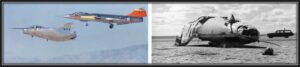
Left: The M2-F2 (lower plane in this photo) before the crash. Right: After crashing on May 10, 1967. (NASA Photos)
Unlike Bruce Peterson, the M2-F2 was rebuilt and made better. Having flipped over six times, the M2-F2 was originally expected to be scrapped. But builder Northrop was able to repair it and implement changes that made it safer to fly. The most obvious addition was a third vertical fin to improve lateral stability. Redesignated the M2-F3, this craft flew 27 more flights and contributed greatly to the lifting body research program. A year after its last flight (in December 1972) NASA donated it to the Smithsonian. You can now see the M2-F3 on display at the Smithsonian’s Udvar-Hazy Center in Virginia.
By the way, it was said that Peterson was not a fan of the TV show—he didn’t appreciate having film of his accident broadcast on national TV every week for much of the 1970s.

Courtesy of AVBRIEF.com
Remembering the fallen who died focusing their attention ahead in devotion and love and not back in hate.
Onward and upward!
Sources: AvBrief.com and NASA