On This Day in Aviation History-The Iranian Rescue Mission
Contributor: Barry Fetzer
Sources: History.com
Now that we’re past Labor Day and the unofficial end of summer, we’re all looking forward to lower temperatures and being bombarded by pumpkin spice fragrances this, and pumpkin spice flavors that…
…well, maybe not the pumpkin spice. I personally have never had pumpkin spice anything, except for cinnamon and nutmeg-laced pumpkin pie, and then not until two and a half months away on Thanksgiving Day. And I’m just fine with that.
So, instead of pumpkin spice, let’s focus on today’s aviation history “twofer”, two events separated by 33 years but related in their “spaciness” (if not their “spiciness”).
On this day in aviation history in 1959 (according to Encyclopedia Britannica, which, yes believe it or not, is still a “thing”), “The Soviet Union launched Luna 2, the first space probe to hit the moon.” Luna 2 further exasperated (and even scared) Americans with their increasing sense of falling behind the Soviet Union from a technological viewpoint. The Luna 2 spacecraft successfully impacted the moon only two years after, Sputnik 1’s success. Sputnik was the first artificial earth satellite.
I was serving on active duty when, on April 24, 1980, and according the History.com editors and downloaded today from: https://www.history.com/this-day-in-history/April-24/hostage-rescue-mission-ends-in-disaster “an ill-fated military operation to rescue the 52 American hostages held in Tehran ended with eight U.S. servicemen dead and no hostages rescued.
I served with many of the Marines who were involved in planning and/or executing this ill-fated mission that, at least in part, resulted in America saying, “never again” and spending our treasure and blood to form our special operations capabilities that led, most recently, to the capture of Venezuela’s President Nicolás Maduro and his wife. The Marines involved in the Iranian Rescue Mission were, on one-hand, humbled at their failure but also certain that better days would lie ahead.
They were right.
“With the Iran Hostage Crisis stretching into its sixth month and all diplomatic appeals to the Iranian government ending in failure, President Jimmy Carter ordered the military mission as a last-ditch attempt to save the hostages. During the operation, three of eight helicopters failed, crippling the crucial airborne plans. The mission was then canceled at the staging area in Iran, but during the withdrawal one of the retreating helicopters collided with one of six C-130 transport planes, killing eight service members and injuring five. The next day, a somber Jimmy Carter gave a press conference in which he took full responsibility for the tragedy. The hostages were not released for another 270 days.
“On November 4, 1979, the crisis began when militant Iranian students, outraged that the U.S. government had allowed the ousted shah of Iran to travel to the U.S. for medical treatment, seized the U.S. embassy in Tehran. The Ayatollah Khomeini, Iran’s political and religious leader, took over the hostage situation and agreed to release non-U.S. captives and female and minority Americans, citing these groups as among the people oppressed by the U.S. government. The remaining 52 captives remained at the mercy of the Ayatollah for the next 14 months.
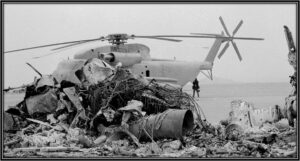
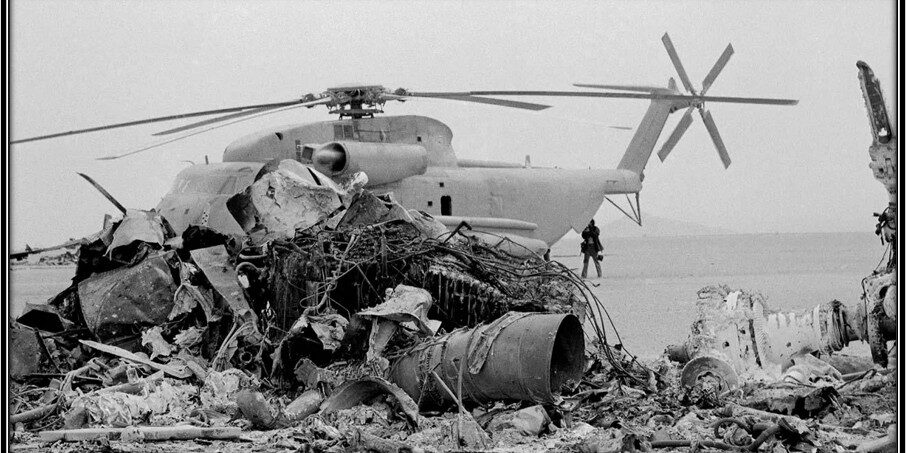
Photo of Desert One site of failed Iranian Rescue Mission, Operation Eagle Claw. Photographer unknown, likely of Iranian origin.
“President Carter was unable to diplomatically resolve the crisis, and the April 1980 hostage attempt ended in disaster. Three months later, the former shah died of cancer in Egypt, but the crisis continued. In November, Carter lost the presidential election to Republican Ronald Reagan, and soon after, with the assistance of Algerian intermediaries, successful negotiations began between the United States and Iran. On the day of Reagan’s inauguration, January 20, 1981, the United States freed almost $8 billion in frozen Iranian assets, and the 52 hostages were released after 444 days. The next day, Jimmy Carter flew to West Germany to greet the Americans on their way home.”
For those of us cognizant in 1980, does the current war against Iran make us feel at all like, “Déjà vu (as baseball catcher Yogi Berra made famous) all over again”? We hope not.
Onward and upward!
Sources: History.com