Valentine’s Day Twofer
Contributor: Barry Fetzer
Sources: History.com, NASA
Good Valentine’s Day evening fellow aviation history aficionados. I hope you remembered to celebrate love on this day, especially the love of our home planet as serendipitously was photographed from the outer reaches of our solar system today, Valentine’s Day, back in 1990.
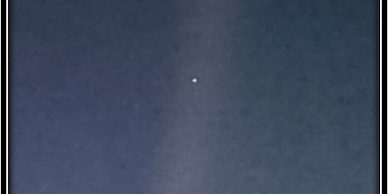
According to History.com editors and retrieved on February 14, 2026 from: https://www.history.com/this-day-in-history/February-14/pale-blue-dot-photo-of-earth-taken-voyager-1?cmpid=email-hist-tdih-2026-0214-02142026&om_rid=, “on Valentine’s Day, 1990, 3.7 billion miles away from the sun, the Voyager 1 spacecraft took a photograph of Earth. The picture, known as Pale Blue Dot, depicts our planet as a nearly indiscernible speck roughly the size of a pixel.
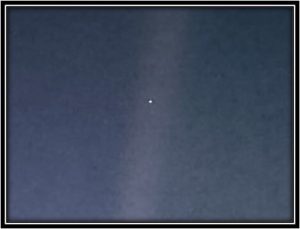
Home: Pale Blue Dot photo courtesy NASA.
“Launched on September 5, 1977, Voyagers 1 and 2 were charged with exploring the outer reaches of our solar system. It passed by Jupiter in March of 1979 and Saturn the following year. The gaps between the outer planets are so vast that it was another decade before it passed by Neptune and arrived at the spot where it was to take a series of images of the planets, known as the ‘Family Portrait’ of our solar system.
“Of the Family Portrait series, Pale Blue Dot was certainly the most memorable. The furthest image ever taken of Earth, it lent its name to popular astronomer Carl Sagan’s 1994 book. Sagan, who advised the Voyager mission and had suggested the photo, wrote the following: ‘Look again at that dot. That’s here. That’s home. That’s us. On it everyone you love, everyone you know, everyone you ever heard of, every human being who ever was, lived out their lives. The aggregate of our joy and suffering, thousands of confident religions, ideologies, and economic doctrines, every hunter and forager, every hero and coward, every creator and destroyer of civilization, every king and peasant, every young couple in love, every mother and father, hopeful child, inventor and explorer, every teacher of morals, every corrupt politician, every ‘superstar,’ every ‘supreme leader,’ every saint and sinner in the history of our species lived there—on a mote of dust suspended in a sunbeam.’
“Voyager 1’s journey continues. In 1998, it became the most distant human-made object in space, and on August 25, 2012, it left the furthest reaches of the sun’s magnetic field and solar winds, becoming the first man-made object in interstellar space.”
And, also on this day in 1943…an event centered on hate and not love…and according to History.com editors retrieved on February 14, 2026 from: https://www.history.com/this-day-in-history/February-14/battle-of-the-kasserine-pass?cmpid=email-hist-tdih-2026-0214-02142026&om_rid= “German General Erwin Rommel and his Afrika Korps launched an offensive against an Allied defensive line in Tunisia, North Africa. The Kasserine Pass was the site of the United States’ first major battle defeat of the war.
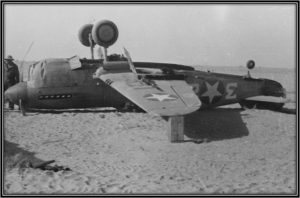
Photo of damaged US P-40 Warhawk taken by an unknown photographer allegedly nearby the Battle of Kasserine Pass, Tunisia in 1943.
“General Erwin Rommel was dispatched to North Africa in February 1941, along with the new Afrika Korps, to prevent his Italian Axis partner from losing its territorial gains in the region to the British. Despite his skill, until this point Rommel had been unable to do much more than manage his own forces’ retreats, but the Battle of Kasserine Pass would finally display the ‘Desert Fox’s’ strategic genius.
“In the Battle of El Alamein in August 1942, British General Bernard Montgomery pushed Rommel out of Egypt and into Tunisia, behind the Mareth Line, a defensive fortification built by Vichy French forces. After taking several months to regroup, Rommel decided on a bold move. Rommel set his sights on Tunis, Tunisia’s capital and a key strategic goal for both Allied and Axis forces.
“Rommel determined that the weakest point in the Allied defensive line was at the Kasserine Pass, a 2-mile-wide gap in Tunisia’s Dorsal Mountains, which was defended by American troops. His first strike was repulsed, but with tank reinforcements, Rommel broke through on February 20, inflicting devastating casualties on the U.S. forces. The Americans withdrew from their position, leaving behind most of their equipment. More than 1,000 American soldiers were killed by Rommel’s offensive, and hundreds were taken prisoner. The United States had finally tasted defeat in battle.