This day in Aviation History: Operation Babylift
Contributor: Barry Fetzer
Sources: History.com, Wikipedia, AP, National Archives and Records Administration
Good Saturday afternoon and best wishes for a blessed Easter to all,
Speaking of Easter and good deeds—we recognized the world’s most sacrificial and good deed, yesterday, on Good Friday—I know you’ve heard the idiom, “No good deed goes unpunished.” Perhaps you’ve experienced the effects of this cynical idiom when some altruistic act you’ve initiated or participated in resulted in negative consequences.
That idiom is really a gross generalization, isn’t it? At least in my experience, there are many good deeds that result in good outcomes and gratitude by those to whom the deed was offered and they don’t backfire into resentment or a lack of appreciation.
Could this day in aviation history event, on the other hand, be an example of that cynical idiom at work?
Or alternatively, was the event a victim of the Fog of War…the reality that in war, if an action is going to happen, it often has to happen fast because there isn’t time to cross all the t’s and dot all the i’s? So, one makes decisions and moves based on the limited information one has at the moment and accepts the consequences, intended and otherwise.
Or was it both?
Today in 1975 according History.com Editors and downloaded from https://www.history.com/this-day-in-history/April-4/operation-baby-lift-concludes?cmpid=email-hist-tdih-2026-0404-04042026&om_rid=,
“Operation Babylift,” transporting South Vietnamese children out of country, started in tragedy
“The American airlift of Vietnamese war orphans to the U.S. and other Western nations began disastrously on April 4, 1975, when an Air Force cargo jet crashed shortly after takeoff from Tan Son Nhut airbase in Saigon. More than 135 passengers, mostly children, were killed. Some of the children had been loaded two to a seat in the plane’s troop compartment; others were strapped more haphazardly to the floor of the cargo bay, with blankets and pillows.
“‘Operation Babylift,’ initiated to bring South Vietnamese war orphans and the children of American servicemen to the West for adoption, was carried out during the final, desperate phase of the war, as North Vietnamese forces were closing in on Saigon. Although the first flight ended in tragedy, subsequent flights over the subsequent weeks took place without incident, up until the fall of Saigon and the end of the war. Ultimately, more than 2,600 children were transported out of their home country.
“While the U.S. government presented the program as a humanitarian mission—President Gerald Ford posed with some of the incoming babies at the San Francisco airport—critics assailed Babylift as poorly planned, politicized and racist. Newspaper headlines read, ‘Babylift or babysnatch?’ and ‘The Orphans: Saved or Lost?’ Some of the children weren’t orphans at all, but had families who had temporarily given up custody under wartime duress. A lawsuit later brought by birth families was thrown out of court, and the records sealed. A lawsuit against Lockheed and the U.S. government, filed on behalf of the doomed first Babylift flight’s injured survivors, ended in a $19.7 million settlement.”
According to Wikipedia and downloaded today from https://en.wikipedia.org/wiki/Operation_Babylift,
“Operation Babylift was a mass evacuation of children from South Vietnam to the United States and other Western countries at end of the Vietnam War, in April 1975. Over 3,300 infants and children were airlifted, although the actual number has been variously reported.
“On 3 April 1975, with the central Vietnamese city of Da Nang having fallen to North Vietnamese forces in March, and with the South Vietnamese capital Saigon coming under siege, U.S. President Gerald Ford announced that the U.S. government would begin airlifting orphans out of Saigon. The airlift would be carried out on a series of 30 planned flights aboard C-5A and C-141 cargo aircraft operated by the 62nd Airlift Wing, under the command of Major Gen. Edward J. Nash of Military Airlift Command (MAC).
“The adoption agency Holt International, along with a number of service organizations including, Friends of Children of Viet Nam (FCVN), Friends For All Children (FFAC), Catholic Relief Service, International Social Services, International Orphans, and the Pearl S. Buck Foundation, petitioned the government to help evacuate the orphans residing in their facilities in South Vietnam. In their book, Silence Broken, International Orphans (now Childhelp) founders Sara O’Meara and Yvonne Fedderson chronicle the request they received from Lt. General Lewis William Walt to help with evacuations and finding homes for the Vietnamese-American orphans, many of whom had been fathered by American servicemen.
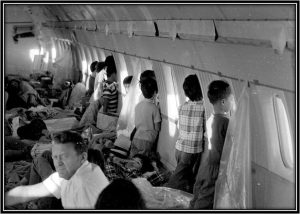
In this April 1975 file photo, orphans aboard this “Operation Babylift” flight at the end of the Vietnam War look through the windows of World Airways DC-8 jet as it flies them to the United States. (AP Photo/File)
“Flights continued until artillery attacks by the People’s Army of Vietnam on Tan Son Nhut Airport rendered airplane flights impossible.
“Over 2,500 children were relocated and adopted out to families in the United States and its allies, including approximately 250 sent to Australia. The operation was controversial because there were questions about whether the evacuation was in the children’s best interest, and because not all the children were orphans.
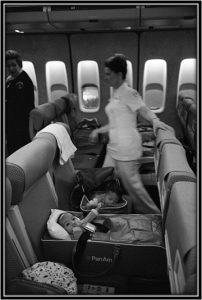
A Babylift flight arrives at San Francisco, 5 April 1975. Photo courtesy of the U.S. National Archives and Records Administration
“When American businessman Robert Macauley learned that it would take more than a week to evacuate the surviving orphans due to the lack of military transport planes, he chartered a Boeing 747 from Pan American World Airways and arranged for 300 orphaned children to leave the country, paying for the trip by mortgaging his house.
“Frederick M. ‘Skip’ Burkle Jr. served as the medical director of Operation Babylift. He gathered the orphans in Saigon, accompanied them to Clark AB (Air Base) in the Philippines, and continued to care for them on a Boeing 747 across the Pacific Ocean to Los Angeles and then Long Beach Naval Support Activity.
The Plane crash
“A C-5A Galaxy, serial number 68-0218, flew the initial mission of Operation Babylift departing from Tan Son Nhut Airport shortly after 4 p.m. on 4 April 1975. Twelve minutes after takeoff, there was what seemed to be an explosion as the lower rear fuselage was torn apart. The locks of the rear loading ramp had failed, causing the door to open and separate, and a rapid decompression. Control and trim cables to the rudder and elevators were severed, leaving only one aileron and wing spoilers operating. Two of the four hydraulic systems were out of service. The crew wrestled at the controls, managing some control of the plane through changes in throttle settings, as well as using the one working aileron and wing spoilers. The crew descended to an altitude of 4,000 feet on a heading of 310 degrees in preparation for landing on Tan Son Nhut’s runway 25L. About halfway through a turn to final approach, the rate of descent increased too rapidly. Seeing they could not make the runway, full power was applied to bring the nose up. The C-5 touched down briefly in a rice paddy, skidding for a quarter of a mile. Next, the aircraft became airborne again for a half mile before hitting a dike and breaking into four parts, some of which caught fire. According to DIA figures, 175 people survived and 138 people were killed in the crash, including 78 children and 35 Defense Attaché Office, Saigon personnel. After this crash, Major General Maurice F. Casey, the Deputy Director for Logistics in the Organization of the Joint Chiefs of Staff, called General Paul K. Carlton, MAC Commander, expressed his sympathy and then confirmed with the State that they wanted to continue these airlifts out of Saigon. Carlton acknowledged that he would use C-141 planes for the evacuations unless conditions forced him to use C-5As. As another added safety precaution, Carlton decided all flights would land and takeoff at Tan Son Nhut only during daylight hours.
Criticism and Legacy
“On 29 April 1975, a lawsuit was filed by Vietnamese born nurse Muoi McConnell on behalf of an ad-hoc group known as the Committee to Protect the Rights of Vietnamese Children, alleging that many children transferred to the United States were not orphans, and were taken without the consent of parents and family members. Many children taken during the operation were placed in orphanages due to poor living conditions by living relatives, and sometimes allegedly under duress. These actions were labelled as kidnapping by periodicals of the time, citing the lack of consent and documentation behind the extraction of children alongside the lawsuit.”
But 40 years later, perhaps with the benefit of 20-20 hindsight and at a reunion of air-lifted children and those who participated in the airlift as described here: https://www.militarytimes.com/news/your-military/2015/04/25/operation-babylift-kids-veterans-reunite-40-years-later/, maybe more appreciation for this intended good deed bubbled…and continues to bubble…to the surface.
Onward and upward!
Sources: History.com, Wikipedia, AP, National Archives and Records Administration