This Day in Aviation History: Beirut Embassy Bombing
Contributor: Barry Fetzer
Sources: History.com, US State Department
All of us have memories indelibly etched in our brains from experiences we’ve had. My brain-etchings are no more important or consequential than anyone else’s and are, in fact, far less significant than the combat experiences of those reading this aviation history vignette.
But still, I remember my “brain-etchings” in Beirut 43 years ago today like they happened yesterday.
We felt the whole mini-aircraft carrier aboard which we were deployed…LPH-7…the USS Guadalcanal…shudder at the moment the US Embassy was destroyed by a suicide truck bomber as described below by the History.com Editors.
I was assigned as section leader of the “ready crew”, a section of two CH-46 helicopters tasked with being prepared to launch from the ship within minutes. The aircraft were spotted on the flight deck of the “Guad”, fueled, pre-flighted, crew and flight briefings completed (including a map study of the Beirut operating area), armed (with 2-50 caliber machine guns mounted on each aircraft with 1000 rounds of belted ammo), and ready to go.
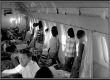
Minutes after the shudder of the embassy explosion, general quarters was sounded aboard our Lady, the USS Guadalcanal. That meant for me and my crewmates to run from her “innards” below deck to man and launch our aircraft. Engines started and rotors turning, we were cleared to take-off 10 minutes after general quarters sounded. Hovering over the flight deck for a final check of aircraft systems we, in order (section leader…me…first and then my wingman) slid left off the deck of the Guad (the ocean about 55 feet below us) and nosed our aircraft down to gain airspeed and then altitude and received a short, in-flight briefing from our CO over the radio that the US Embassy had been bombed. “Proceed to the US Embassy,” he ordered, “and conduct medivacs”.
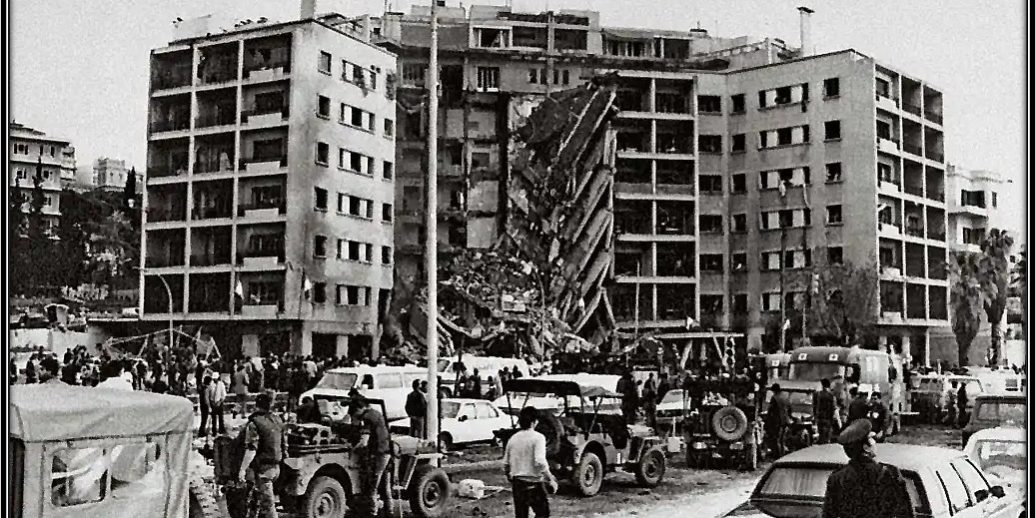
Aftermath of the attack on the U.S. Embassy in Beirut, 18 April 1983 (AP/World Wide Photos, www.state.gov)
After a low fly-over of the bomb debris-littered street in front of what remained of the US Embassy in what was once named “The Paris of the Middle East”, we found suitable landing spots and landed. We immediately started taking-on litters of injured and dead bodies from the US Embassy. It was too early in the mission for body bags. Horribly burned, crushed, and amputated, the dead were loaded into our aircraft. To this day, I hope some of those we brought back to the USS Guadalcanal thought to be dead, in fact, were saved.
In the CH-46 helicopter, the air flows from aft in the cabin of the aircraft up into the cockpit and through the little cockpit sliding plexiglass windows installed in the aircraft. I vividly recall (there’s that brain-etching again) the smell of “burnt chicken” flowing though the cockpit.
I would later lose my best friend in the fighting in Beirut before President Reagan ordered all Marines out.
According to the History.com editors and downloaded today from https://www.history.com/this-day-in-history/April-18/suicide-bomber-destroys-u-s-embassy-in-beirut?cmpid=email-hist-tdih-2026-0418-04182026&om_rid=
“The U.S. embassy in Beirut, Lebanon, was almost completely destroyed by a car-bomb explosion that kills 63 people, including the suicide bomber and 17 Americans. The terrorist attack was carried out in protest of the U.S. military presence in Lebanon.
“In 1975, a bloody civil war erupted in Lebanon, with Palestinian and leftist Muslim guerrillas battling militias of the Christian Phalange Party, the Maronite Christian community, and other groups. During the next few years, Syrian, Israeli, and United Nations interventions failed to resolve the factional fighting, and on August 20, 1982, a multinational force featuring U.S. Marines landed in Beirut to oversee the Palestinian withdrawal from Lebanon.
“The Marines left Lebanese territory on September 10 but returned on September 29, following the massacre of Palestinian refugees by a Christian militia. The next day, the first U.S. Marine to die during the mission was killed while defusing a bomb, and on April 18, 1983, the U.S. embassy in Beirut was bombed. On October 23, Lebanese terrorists evaded security measures and drove a truck packed with explosives into the U.S. Marine barracks in Beirut, killing 241 U.S. military personnel. Fifty-eight French soldiers were killed almost simultaneously in a separate suicide terrorist attack. On February 7, 1984, U.S. President Ronald Reagan announced the end of U.S. participation in the peacekeeping force, and on February 26 the last U.S. Marines left Beirut.”
And by the way: this was the largest killing in the history of the CIA too. Let’s not forget those sacrifices too.
Onward and upward!
Sources: History.com, US State Department