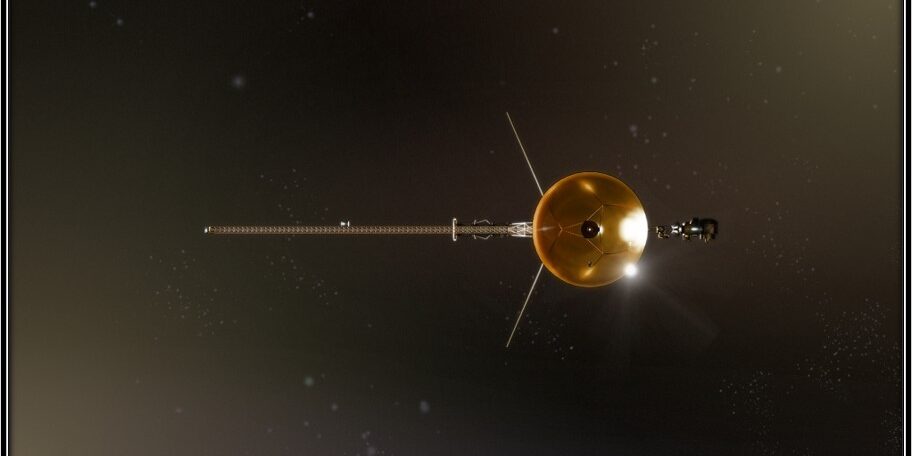
NASA’s interstellar Voyager 1 probe is about to reach 1 light-day from Earth after nearly 50 years in space
I have an idea! Let’s have some fun with math!
Light travels, we all learned in grade school, at 186,000 miles per second. That’s 669,600,000 (almost 670 million) miles per hour according to my “Jethro Bodine cipherin’ skills” (Jethro Bodine of the “Beverly Hillbillies” that aired on CBS from 1962 to 1971 for those too young to remember that TV show).
Again, thanks to Jethro, all we need to do is simply multiply that almost 670 million miles per hour times 24 hours in a day to determine about how far Voyager 1 will have travelled the day after tomorrow on November 18th when it hits it’s one light-day mark.
Okay. Hmmm. Let’s see. Scratching my head. Licking my pointing finger. *Zero times four is zero, seven times four is 28, carry the two, six times four is 24, which makes 26. Two times zero is zero, two times seven is 14, carry the 1, two times six is 12, which makes 13.* Add everything up and voila’!
That’s about 16 billion, 80 million miles Voyager 1 will have traveled coming up on 50 years of its, now, interstellar travel, give or take a few hundred thousand miles.
Close enough for government work. And all done without the help of a cell phone or a calculator 😊.
Or, that 16,080,000,000 miles can also be written as 1.608e10 using scientific notation, the “e” standing for “exponent” and, in this case, “to the power of ten”.
Jethro, while he knew how to skin a possum, even with his cypherin’ skills, he probably didn’t know about scientific notation. But I hate to assume. Granny might tan my hide if I do.
- Enough “fun with math” for now. Let’s talk Voyager 1’s milestone. The below column was written by Elizabeth Howell and downloaded today from: https://www.space.com/space-exploration/voyager/nasas-interstellar-voyager-1-probe-is-about-to-reach-1-light-day-from-earth-after-nearly-50-years-in-space?utm_term=80CFE072-3D22-4ED3-B366-38D5778C5AB2&lrh=979456b06da101021af8477d820fe42a8b8fac61060c8f48a99307e6facca454&utm_campaign=58E4DE65-C57F-4CD3-9A5A-609994E2C5A9&utm_medium=email&utm_content=E7069DBD-AF10-47C6-BB2A-32C5E360F791&utm_source=SmartBrief
A light-day, as the name implies, represents the distance that light travels in a single day.
Voyager 1 is celebrating a big milestone as it approaches its 50th birthday: reaching one light-day away from Earth.
NASA’s long-running interstellar Voyager 1 probe will mark one light-day of distance from Earth on Nov. 18, when the spacecraft is 49 years, two months and 11 days old. The agency recently stated the record distance, which will be reached at 5:16:07 a.m. EST (101607 GMT) is “a huge milestone by any measure, and a day worth celebrating.”
During the light-day crossover, Voyager will be in contact with the Madrid station of the three-antenna Deep Space Network that monitors all deep-space missions. The spacecraft is currently making its way through the constellation Ophiuchus from the perspective of Earth, said Jeffrey Hayes, a NASA official whose work includes Voyager 1.
Voyager 1 (Image credit: NASA/JPL-Caltech)
“This [milestone] essentially kicks off the years’ worth of celebrations leading up to the 50th anniversary in August and September of next year,” added Hayes, who is discipline scientist in the agency’s astrophysics and heliophysics divisions, in a livestreamed discussion with NASA’s Night Sky Network on Nov. 4.
Going the distance
Voyager 1 is the farthest spacecraft from Earth, after launching from Kennedy Space Center in Florida on Sept. 5, 1977 a few weeks after its twin, Voyager 2.
Onward and upward!
Sources: www.space.com and NASA